
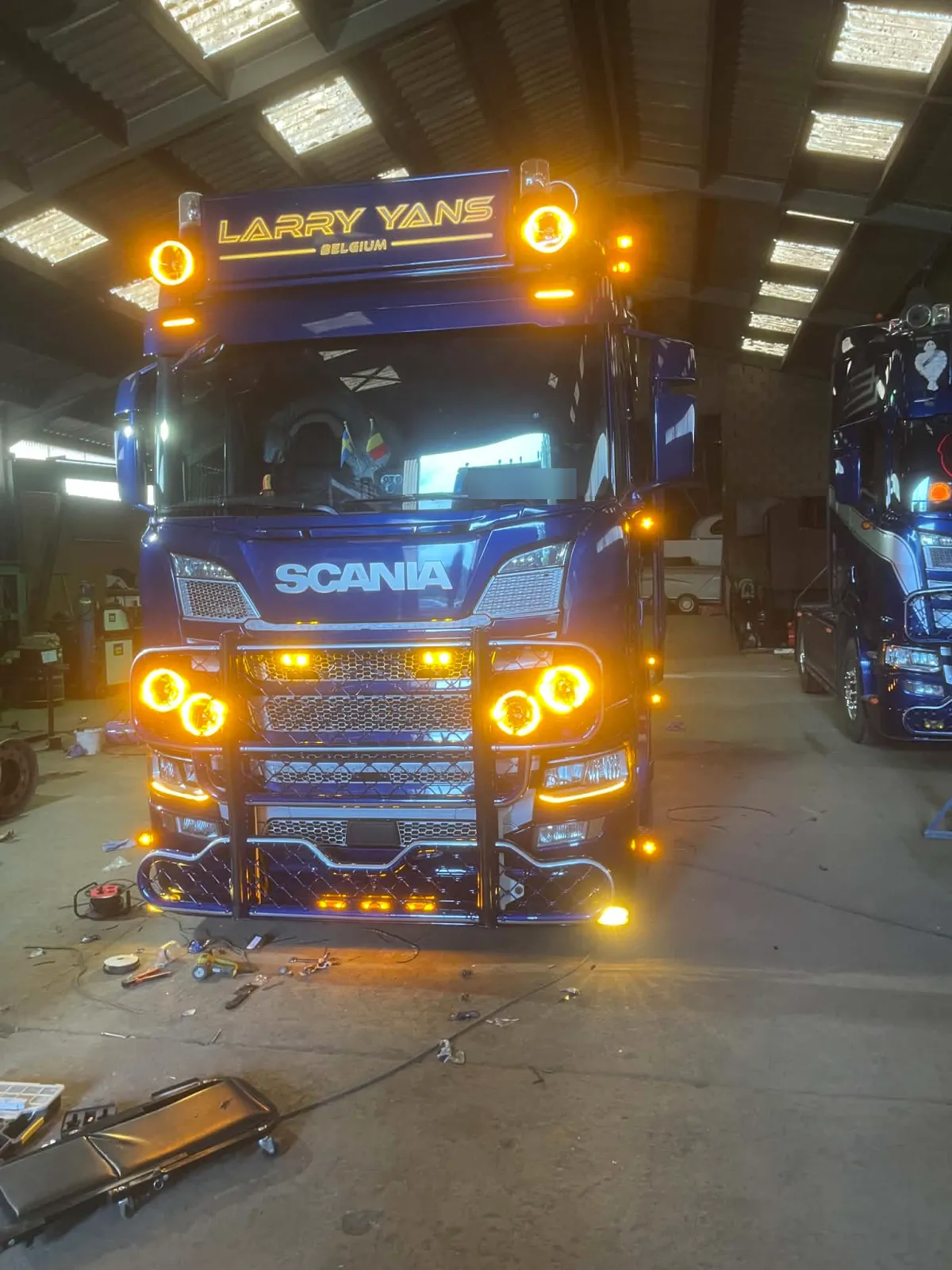
First: what kind of road?
Before talking lumens, I always ask the same question: where do you drive at night? The answer decides almost everything else.
- Motorway and long straight roads: you need to see far ahead. A concentrated beam does the job.
- Country roads, bends, small villages: seeing far is not enough, you also need to light the verges (a cyclist, a deer, a farm entrance).
- Building sites, quarries, car parks at night: here we are talking about work lights, which light a wide area close by, when stationary.
Most of the drivers I fit out do a bit of everything. That is why the choice of beam matters as much as power.
Lumens, lux, reference number: the three figures to read
Lumens: the quantity of light
This is the total light coming out of the lamp. Be wary of data sheets that quote very high “raw” lumens: what counts are the effective lumens, measured at the lamp's output. The gap between the two can be huge.
Range at 1 lux: the useful distance
This is the distance at which the lamp still lights with 1 lux, roughly the light of a full-moon night. To compare two lamps, it is the most telling figure.
The reference number: the one people forget
It is engraved on the lens of an approved lamp (for example Ref. 12.5, 17.5, 37.5). It corresponds to the lamp's maximum intensity, roughly divided by 4,300. A small number gives a wider beam, handy on winding roads; a large number carries further, in a straight line.
Narrow, wide or mixed beam?
| Beam | What it does | Who it suits |
|---|---|---|
| Narrow (“spot”) | Concentrated light straight ahead, carries very far | Long straight roads, motorway |
| Wide (“flood”) | Light spread to the sides, carries less far | Manoeuvring, building sites, work lights |
| Mixed (“combo”) | A centre that carries far and lit sides | Everyday driving, the most common choice |
For a truck that mostly drives on the road, I most often recommend a pair with a mixed beam, or a narrow beam if your original lights already light the sides well.
Round, rectangular or LED bar?
Round lights (7 or 9 inch) remain the most requested on the trucks I customise: they carry far, they last, and let's be honest, on a roof bar or a bull bar they look great. The 9 inch has more surface, so often more range; the 7 inch fits more easily on a grille or between two existing lights.
LED bars light a wider area and give a more modern look. I have written a whole guide on the question: LED bar or long-range lights?
The rule not to forget: 100 in total
This is the European rule many people discover too late: the sum of the reference numbers of all the truck's main-beam lights cannot exceed 100 (which corresponds to 430,000 candela). Your original main beams count towards the total.
Calculation example
Original main beams each engraved Ref. 25: 25 + 25 = 50. That leaves 50. So you can add two Ref. 25 lights, or four Ref. 12.5 lights, but not two Ref. 37.5 lights (50 + 75 = 125).
Before ordering, I note the numbers engraved on your original lights. If you cannot find them, send me a clear photo of the lens and I will tell you.
Approval: what I check before fitting
- The E mark in a circle, followed by a country number: this is the proof that the lamp is approved in Europe.
- Regulation R112 or R149 for a main-beam lamp (R149 is gradually replacing R112).
- Regulation R10: electromagnetic compatibility. Without it, poor-quality LED electronics can interfere with the radio, the CB or other equipment on the truck.
- No “off-road” mention: those lights are made for private tracks, not for the road.
There is also a simple rule of use: long-range lights are main-beam lights. They must switch off when you go back to dipped beam. So I wire them to the main-beam control.
Where to fit them on a truck?
On a roof bar
Placed high, the lights see far over the traffic and are not exposed to stones. The downside: in rain or fog, light coming from above reflects more towards the driver.
On the grille or a bull bar
Lower, closer to the road: the verges are better lit, and it is more comfortable in bad weather. It is also the most visible position for the look. To choose the support: my bull bar guide.
On many trucks, both are combined, staying within the total of 100.
Fitting: where everything is decided
A good light badly wired is still a bad installation. What I do on every job:
- a dedicated relay and fuse, so as not to overload the original circuit;
- cables of the right gauge and waterproof connectors, because a truck lives outdoors, in salt and rain;
- protected cable runs, with no rubbing on the chassis or on the tilting cab;
- aiming the lights once the truck is level, to light the road and not the mirrors of oncoming vehicles;
- a full test before handing you the keys.
The key points
- Your use: motorway, country roads or building site
- Range at 1 lux and effective lumens, not “raw” lumens
- The beam: narrow, wide or mixed
- The reference number, and the total of 100 with your original lights
- The E mark, R112 or R149, and R10
- Wiring with a relay, fuse and waterproof connectors