
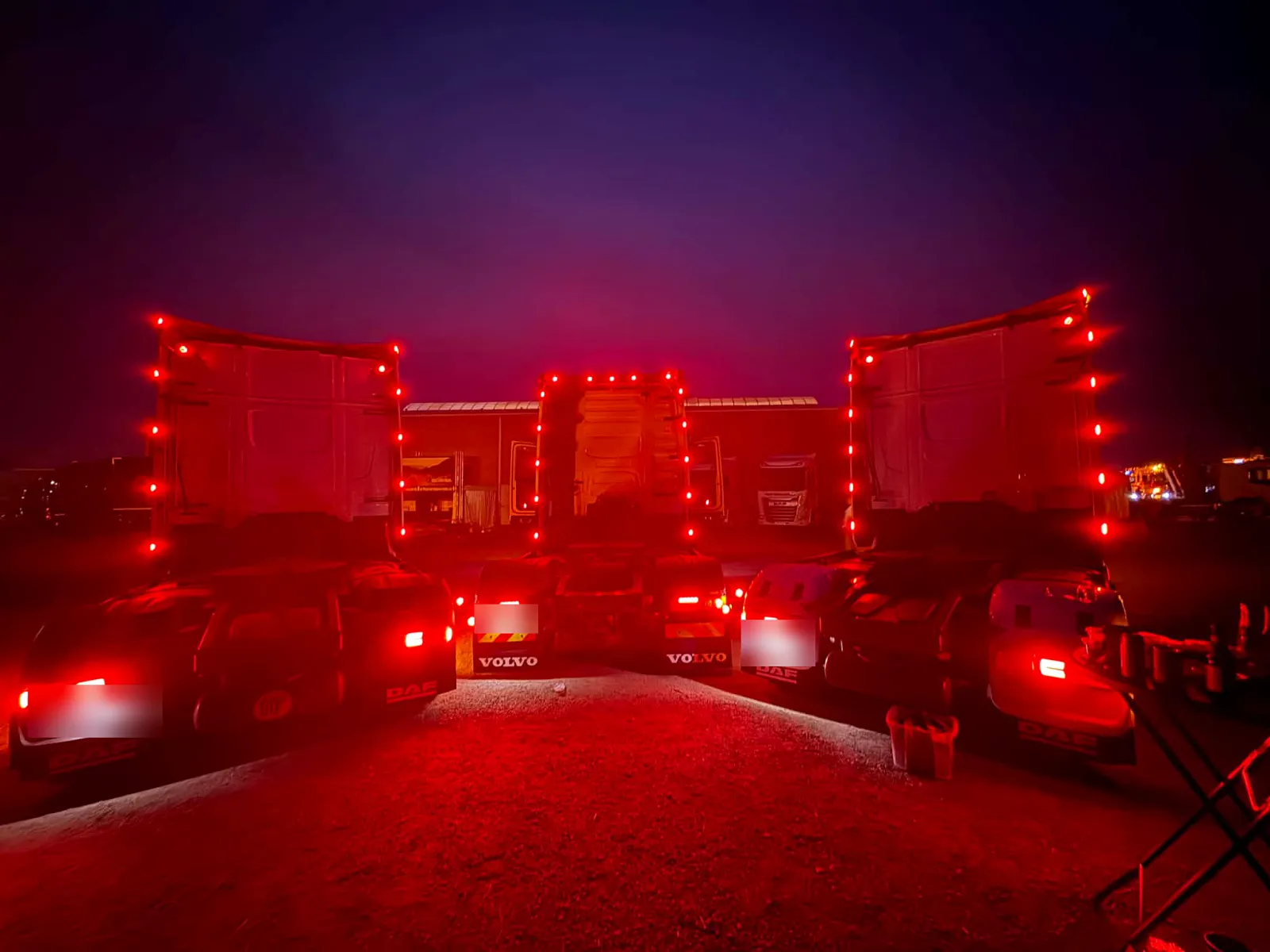
The basic rule: white at the front, red at the rear, amber on the side
Remember this sentence, it settles 90% of the questions:
| Where on the truck | Colour | Examples |
|---|---|---|
| At the front | White | Front position lights, front marker lights, headlights |
| At the rear | Red | Rear position lights, rear marker lights, brake lights |
| On the side | Amber (orange) | Side marker lights, indicators |
Two prohibitions follow from this rule: no red light visible from the front, and no white light visible from the rear, except reversing lights and the number plate light.
One exception to know: the last side light, right at the rear, may be red if it is grouped with a rear light.
Position, marker, side: three lights people confuse
The position light
This is the “basic” light that shows the truck is there, at night. White at the front, red at the rear.
The marker light (or clearance light)
It looks a lot like the position light, but it is placed as high and as far out as possible: it shows the width and height of the vehicle. It is compulsory on vehicles over 2.10 m wide, so on trucks and trailers. White towards the front, red towards the rear.
The side marker light
These are the small amber lights lined up along the side of the truck and trailer. They are compulsory on vehicles over 6 m long, so that the length of the whole combination can be seen at a junction.
The rubber-arm light
This is a marker light mounted at the end of a flexible arm, often at the rear corners of a trailer or a body. When you brush a wall or a dock, the arm bends instead of breaking. It comes in a two-colour version, with white at the front, red at the rear and amber on the side: each face has the right colour.
Same light, three colours: which one to take?
Many marker lights exist in all three colours, with exactly the same housing. It is handy for a uniform look all round the truck, but you must put the right colour in the right place:
| Version | Where to fit it | To avoid |
|---|---|---|
| White | At the front: top of the cab, top of the body, front corners of the trailer | Visible from the rear |
| Red | At the rear: deflector seen from behind, top of the body, rear corners | Visible from the front |
| Amber | On the sides: chassis, skirts, trailer sides | Facing forwards or backwards |
Two-colour models (for example white and amber) are made for corners: one face lights forwards in white, the other lights the side in amber.
And the amber lights on the roof, facing the road, that you see on many show trucks? Facing forwards, it is not a colour meant for a position light. So I wire them on a separate switch, to switch them on only when stationary, at a show or on private ground.
What changes from one colour to another
- White: the colour of the front. For cab or ambient lighting, you also choose the shade: a cool white (bluish) looks modern, a warm white (yellowish) is softer on the eyes at night.
- Amber, orange, yellow: for the rule, it is the same colour (“selective yellow”). It is the colour of the sides, indicators and work beacons.
- Red: the rear, and only the rear.
- Blue: reserved for priority vehicles (police, fire brigade, ambulances). Never on a truck, even as decoration left on while driving.
- Green, purple, multicolour: purely decorative, switched on when stationary.
A classic trap: it is the colour of the light that counts, not that of the glass. A light with a clear lens may very well shine orange or red. I always look at the data sheet and the marking, not just the appearance.
How to know whether a light is approved
A light made for the road carries an E in a circle, followed by a number (the country that approved it), and letters that say what it is for:
- A: front position or marker light (white);
- R: rear position or marker light (red);
- SM1 or SM2: side marker light (amber).
No marking, or an “off-road” mention: the light is not made for the road. It can be fitted as decoration, on a separate switch, but it does not replace a compulsory light.
Also check the voltage: a truck runs on 24 volts. Most recent LED lights accept 12 and 24 V, but it is written on the data sheet.
BA15S-base LED bulbs: what to know
The BA15S base is the small bayonet bulb with two pins opposite each other and a single contact at the end. It is found in many rear lights, older marker lights and ceiling lights.
Replacing these bulbs with LEDs is tempting: less consumption, longer life. Two things to know:
- In a compulsory light (brake, indicator, position), a replacement LED bulb is only accepted if it is approved for that light, and most are not. For the interior, ambient lighting or decorative lights, there is no such issue.
- Indicators that race: an LED draws so little that the flasher unit thinks the bulb has blown and flashes twice as fast. I fix that with a relay made for LEDs or a resistor.
Beacons and flashers
An orange beacon or flasher is not a decorative accessory: it is reserved for certain vehicles and certain situations (recovery, building work, abnormal loads, slow vehicles…), and it is only switched on when the danger justifies it.
Before fitting, I go through the use of the truck with you, and I provide a separate switch with an indicator in the cab. Blue is reserved for the emergency services. To find out more, see my page on truck beacons.
Decorative lights on show trucks
Amber roof bars, coloured LED modules, lights under the bumper, deflector lighting: on a customised truck, that is the whole point. The rule is simple: everything that is not a compulsory, approved light is wired on a separate switch, switched on when stationary, in a car park or at a show.
That is how I wire in the workshop: each group of lights on its own switch, with relay and fuse, to keep a truck legal on the road and good-looking when parked.
What I have in stock
I keep some of these lights at the workshop: marker lights in all three colours, position lights, rubber arms, BA15S LED bulbs, LED modules and small flashers. The stock changes every day.
To find out what is available today and at what price, ask the assistant “A question?” at the bottom right (for example: “do you have amber marker lights?”), or send me a message. I can also order what I do not have.
The key points
- White at the front, red at the rear, amber on the side
- Never red towards the front or white towards the rear
- An E mark with the right letter (A, R, SM)
- 24 V (or 12/24 V) on a truck
- Decorative lights on a separate switch
- A beacon only if your activity allows it