What is a bull bar for?
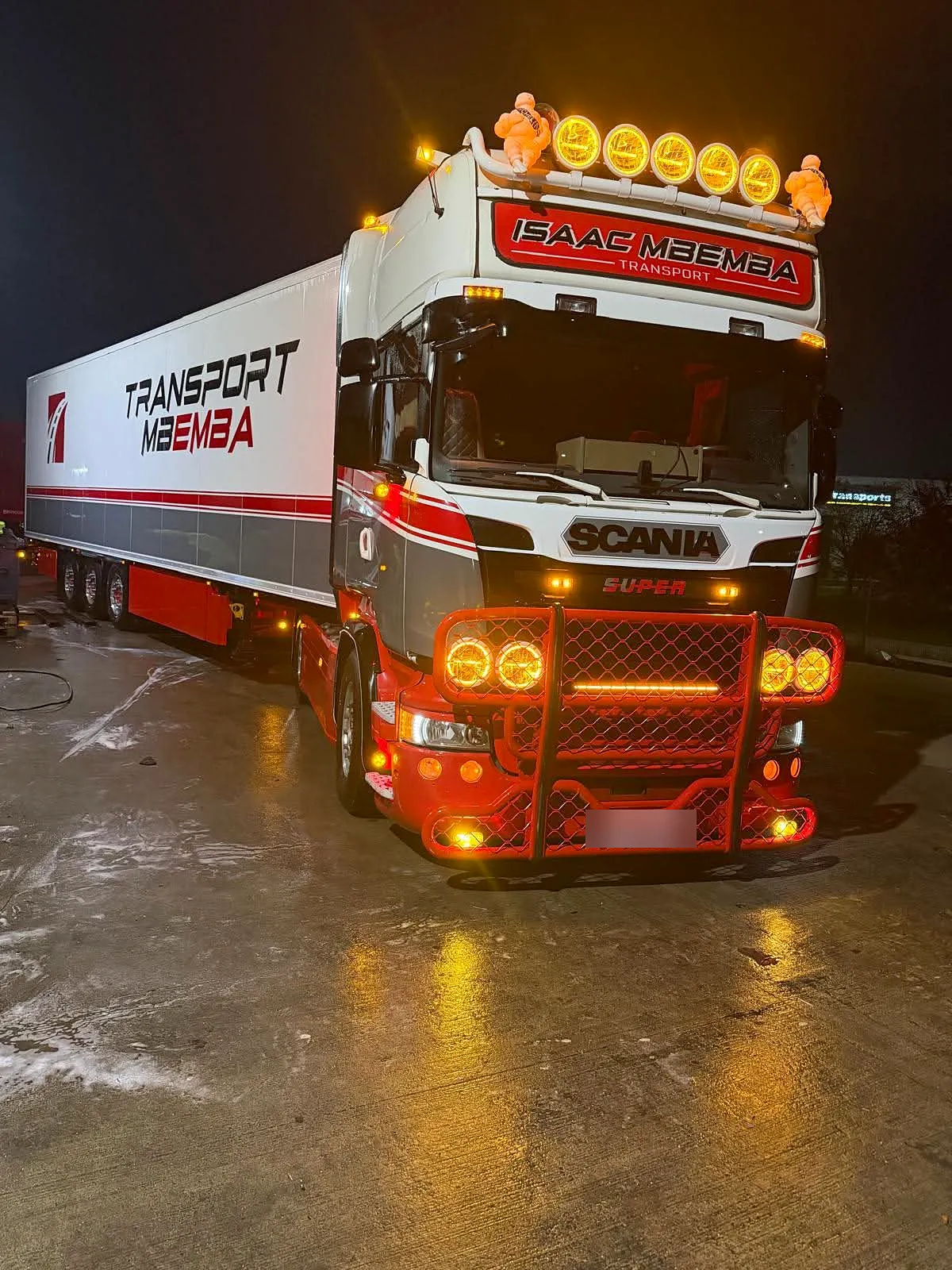
Let's be honest: on a heavy truck, it is fitted first and foremost for the look. It is the part that gives the front of the truck all its character, even more when it is loaded with lights.
It also has a practical side: it is the best support for long-range lights or extra position lights, placed low, close to the road. And it slightly protects the lower grille and bumper from the small knocks of everyday life (manoeuvring, stones).
However, it is not a crash protection: it does not replace the structure of the truck and will not protect you from a real impact.
Low, high or full: the three main families
| Model | What it looks like | Who it suits |
|---|---|---|
| Low bull bar | One bar (or two) under the bumper, following its shape | Discreet look, drivers who just want to underline the front |
| High bull bar | Uprights rising in front of the grille, with a top bar | The “show truck” look, often with round lights |
| With light mounts | Low or high, with plates for 2, 4 or 6 lights | Those who want to light far and low, without drilling the grille |
There are also models with a mesh or crossed tubes. It is a matter of taste, but the more loaded the bull bar, the more you must check that it hides nothing important (more on that below).
Polished stainless or black: the material
Polished stainless steel
This is the great classic on customised trucks: it shines, it does not rust and it can be brought back with polish if it dulls. It is the one that goes best with chrome hubcaps and a chrome grille.
Black (painted or powder-coated steel)
More discreet, more modern, it suits a dark cab or a black grille. The paint needs touching up if it chips, otherwise rust eventually sets in.
In both cases, look at the thickness of the tubes and the quality of the welds: a bull bar that vibrates on the road can be heard in the cab and ends up cracking the mounts.
Is it allowed on the road?
On a truck, yes, provided you respect a few common-sense rules found in the technical regulations and at the roadworthiness test:
- no pointed or sharp parts or dangerous protrusions: the ends must be rounded and follow the shape of the front of the truck;
- the front number plate must remain clearly visible and legible;
- the original lights (dipped, main beam, indicators, position) must not be hidden;
- lights added to the bull bar must be approved, and count towards the total of main-beam lights.
And on a van?
For vehicles under 3.5 tonnes it is stricter: European pedestrian protection rules require a bull bar approved for that vehicle model. A “universal” or home-made model is not accepted.
Decorative lights (colour, amber towards the front) are wired on a separate switch, so they are only switched on when stationary, at a show or on private ground.
Before ordering: what I check on your truck
A bull bar is chosen for a make, a model and a generation of cab. A Scania R from before 2016 and a new-generation Scania R do not use the same mounts. Before ordering, I look at:
- the radar and the camera: on recent trucks, the radar for emergency braking and adaptive cruise control is often in the bumper or behind the grille. The bull bar must not be in front of it, otherwise the system faults;
- the tilting cab: the bull bar must not hinder the cab tilting for maintenance;
- the grille hatch and the step for cleaning the windscreen: they must still open and stay accessible;
- the front towing hook, if there is one;
- the weight: a large stainless bull bar weighs several tens of kilos on the front axle, to keep in mind if you are already close to the limit.
The simplest: send me a front photo of your truck, with the make, model and year. I will tell you what fits.
Lights on the bull bar
It is the ideal place for a pair (or two) of long-range lights: placed low, they light the road and the verges well, and they stay comfortable in rain or fog. Two points not to forget:
- the rule of 100: the sum of the reference numbers of all main-beam lights, original lights included, cannot exceed 100;
- long-range lights are main-beam lights: they switch off when you go back to dipped beam.
I have written a complete guide on this: how to choose long-range LED lights.
Fitting: on the chassis, not on the plastic
A truck bull bar is fixed to the chassis, with brackets made for the model, never only to the plastic bumper. In the workshop, I:
- offer up the bull bar to check the alignment, the height and the space around the radar;
- tighten the fixings to the right torque, with stainless or corrosion-protected hardware;
- run the light cables in sleeves, away from rubbing, with relay, fuse and waterproof connectors;
- tilt the cab once to check nothing touches;
- aim the lights with the truck level, then do a road test.
I do it in my Ciplet workshop, or directly at your place if the truck cannot stay off the road.
Maintenance, especially in winter
Stainless steel does not rust, but road salt and road dirt eventually dull it and mark the welds. A rinse with clean water after salty periods, a mild cleaner (no acid) and a bit of polish from time to time are enough to keep it like new. Also remember to check the fixings when the truck is serviced: vibrations eventually loosen what is not checked.
The key points
- The look: low and discreet, or high “show truck”
- Polished stainless or black
- A model made for your cab (make, model, generation)
- The radar, the tilting cab and the hatch kept clear
- Approved lights, within the total of 100
- Fixing to the chassis and clean wiring